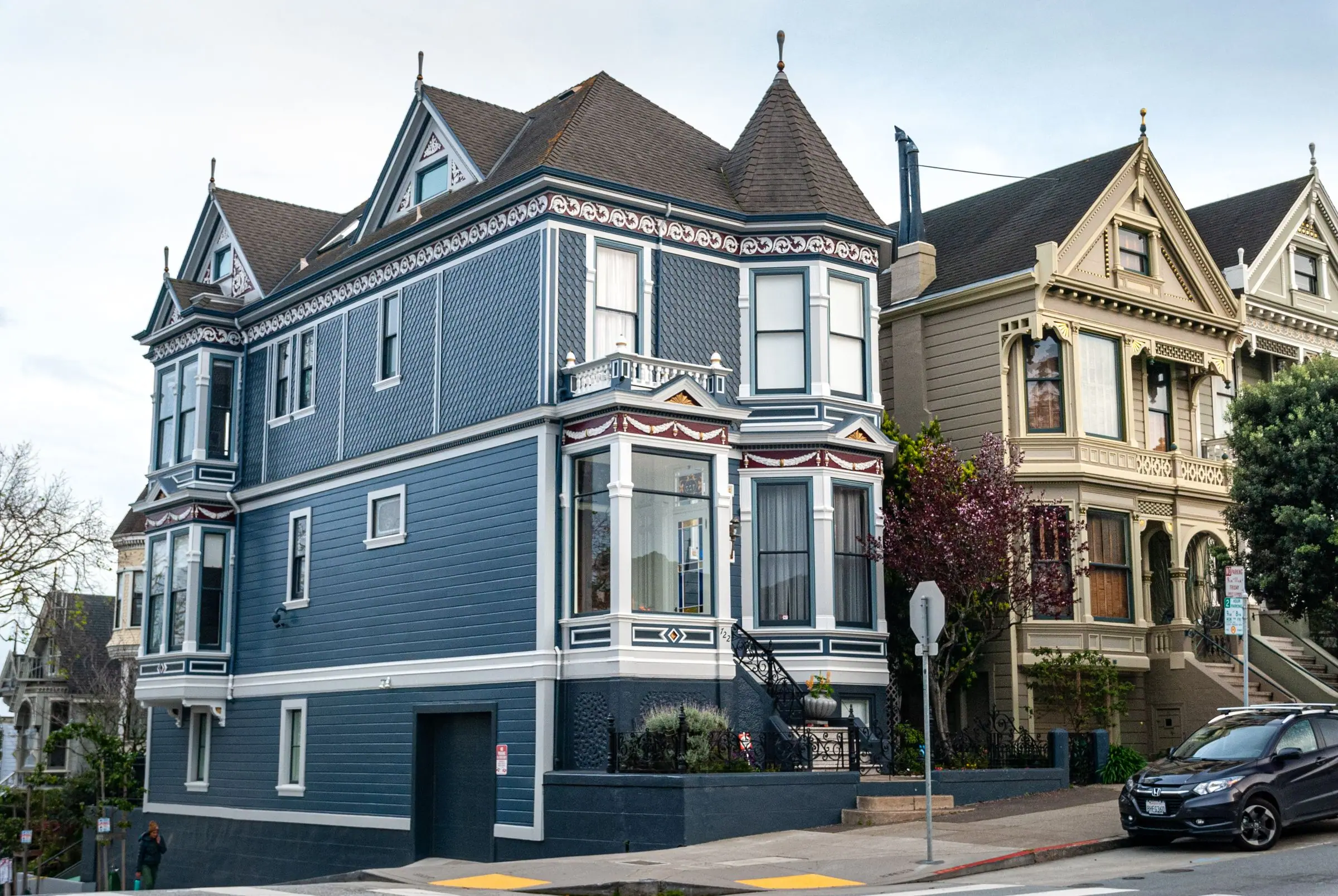
Planning to fix up the house you buy? From a new bathroom to a full remodel, this chapter explains how permits work in San Francisco, which projects get approved quickly and which take months, and how to find a contractor who does good work. In SF, the permit process often sets your schedule more than the construction does. Simple work can be approved the same day. Anything that changes the outside of the building can mean months of city review and possibly a neighbor objecting.
The short version
- Over-the-counter (OTC) permits cover 90%+ of DBI permits. In FY25, 63% of OTC permits were issued within 2 business days. Plan-check work typically takes weeks to months, and anything Planning touches takes months.
- Exterior changes and additions trigger Planning review. Many of them also trigger Section 311 neighbor notification: a 30-day notice period and possible Discretionary Review, which adds months.
- Electrification rules expanded. New construction has been all-electric since 2021. Since July 1, 2026, "major renovations" also have to go electric, subject to exemptions.
- Seismic work is often money well spent. Voluntary retrofits of soft-story houses over garages can qualify for state grants (up to $3k for Brace + Bolt, up to $13k for soft-story) and lower earthquake premiums.
- Vet contractors with records, not just reviews. Check the CSLB license, $25k bond, and workers' comp, then use our contractor index to see who actually pulls permits for your kind of job, at your budget, in your neighborhood.
The four permit paths, and how long each takes
The Department of Building Inspection (DBI) issues building permits. It has four main processing tracks, and which one your project lands in affects your timeline more than anything your contractor does. "Over the counter" (OTC) means a permit approved quickly without a long review. "Plan check" means city staff review your drawings in detail. SF Planning is a separate department that reviews how a project looks and fits the neighborhood.
| Path | Typical scope | Typical time to permit |
|---|---|---|
| OTC, no plans (often online via PermitSF) | Like-for-like replacements: water heater, re-roof, in-kind windows, doors, and siding | Same day to a few days |
| OTC with plans | Kitchen or bath remodel without layout changes, small decks, foundation bolting, minor structural work, where each reviewing station can finish in under an hour | Same day to about 2 weeks |
| In-house plan review | Interior alterations beyond OTC, structural changes, larger remodels | About 6–12 weeks for a standard interior alteration |
| With Planning review | Exterior changes visible from the street, additions, decks above a certain height, unit changes | About 3–6 months |
| Site permit + addenda | New construction, major expansions | About 9–18 months for residential new construction |
The time ranges come from a June 2026 analysis of DataSF permit records, and your project will vary. Two numbers help set expectations: over 90% of DBI permits go OTC, and in FY25 63% of OTC permits were issued within 2 business days. The slowest step in SF is almost always Planning, not DBI's plan check.
Things that push you out of OTC:
- project valuation in the low six figures or more,
- historic status (landmarks, conservation districts, "Category A" historic resources),
- Section 311 neighbor notification,
- an occupancy or unit-count change,
- slope or seismic-hazard-zone geotechnical (soil and slope) review,
- significant structural work.
Since February 13, 2026, in-kind window, door, and siding replacement permits have to be filed online through PermitSF. The Permit Center no longer accepts them in person.
Permit fees
DBI permit fees are based on the project's estimated value. Planning, the Fire Department, Public Works, and utilities can add their own fees. We don't quote a single number because fees depend so much on scope and value. Use DBI's published fee tables (on sf.gov), and have your contractor or permit expediter (a consultant who handles permit paperwork) estimate the full set of fees before you sign.
Planning review, neighbor notification, and historic districts
Section 311 neighborhood notification applies to certain projects in residential and neighborhood-commercial districts, typically additions, expansions, and some exterior changes. Planning mails notice to owners and occupants within 150 feet, and neighbors get 30 days to file a Discretionary Review (DR) request, which asks the city to take a closer look. A DR request sends the project to a Planning Commission hearing, which commonly adds 4–8 months.
How to lower the odds of a delay:
- Talk to the neighbors early. Pre-application meetings are required for some projects, and they're a good idea for all of them. The neighbor whose light you'd block has a lot of say in how smoothly this goes.
- Stay within what the code already allows. The Planning Code allows certain rear-yard extensions (for example, some 1–2 story pop-outs up to 12 feet deep) without a variance (special permission to break a rule), subject to limits.
- Know your historic status. SF Planning classifies properties as Category A (known historic resource), B (older than 45 years, not yet evaluated), or C (not a resource). A and B properties face preservation review for exterior work, and Article 10 landmarks and Article 11 conservation districts add more. Many Victorian and Edwardian blocks are Category A or B. Look up your parcel on the SF Property Information Map before you design.
Earthquake retrofits
Required retrofits for larger buildings (5+ units)
A "soft story" is a ground floor weakened by large openings, like garage doors. SF's Mandatory Soft Story Retrofit Program covers wood-frame buildings with 5+ units and 2+ stories over a soft or weak story, permitted before 1978. All compliance deadlines have passed, and about 4,650 of about 4,940 buildings had complied by early 2025. If you're buying a condo or TIC (tenancy-in-common, a shared ownership of the whole building) in one of these buildings, confirm it has a certificate of final completion (DataSF has a map). Buildings that haven't complied face enforcement.
Voluntary retrofits for houses
Single-family homes and 2–4 unit buildings aren't covered by the mandate, but many SF houses are effectively soft-story: living space over a garage, sitting on a short wood "cripple wall" between the foundation and first floor. Typical voluntary work:
- Bolt and brace. Anchor the house to the foundation and brace the cripple walls with plywood. This often qualifies for an OTC permit.
- Soft-story strengthening. Steel frames or plywood shear walls at the garage opening, designed by an engineer under FEMA P-1100 or the city's standards.
- Foundation replacement for unreinforced brick or badly deteriorated foundations. This is a major project with an engineer, plan review, and often moving out for a while.
Money available:
- Earthquake Brace + Bolt: up to $3,000 for bolt-and-brace, plus up to $7,000 more for income-qualified owners, in eligible ZIP codes.
- Earthquake Soft-Story (ESS): up to $13,000 for qualifying owner-occupied houses over garages, in program ZIP codes.
- CEA premium discount: up to 25% off California Earthquake Authority insurance once the retrofit is verified. See Insurance & earthquakes.
Find the contractors who do this work most often: seismic retrofit → and foundation → specialists, ranked by DBI permits filed.
ADUs and unpermitted units
An ADU (accessory dwelling unit) is a second, smaller home on the same property, like an in-law unit. SF allows them broadly, including garage and ground-floor conversions, detached backyard units, and units added to multifamily buildings.
| Rough 2026 figures (secondary sources) | |
|---|---|
| State-mandated review clock | 60 days from a complete application. SF asks applicants to sign a tolling declaration. |
| Typical DBI + Planning time | About 14–22 weeks for a typical ADU, longer with neighbor notification |
| Detached ADU, start to finish | About 12–18 months |
| Detached ADU all-in cost | Roughly $300k–$550k |
| Permit and agency fees | Five figures, varying widely with utility connections |
(A tolling declaration pauses that 60-day clock while SF reviews.) Since a July 2025 SF law implementing state AB 1033, qualifying ADUs can be sold separately as condos, which gives you a new option when you eventually sell.
Unwarranted units (units built without permits) are a different problem. If you bought a house with an illegal downstairs unit, SF's 2025 rules generally require legalization if Planning finds it during a permit review, and removing it without approval can bring large fines. State AB 2533 makes it easier to legalize units built before 2020 and waives some fees. Get a pre-application consult before you design a remodel that touches that floor. See SF property types decoded.
Browse contractors with ADU permit history: ADU builders →.
Electrification and gas rules
- New construction in SF has had to be all-electric since 2021. After the Ninth Circuit struck down Berkeley's gas ban in 2023, SF amended its rules to exempt appliances covered by the federal Energy Policy and Conservation Act (EPCA), but it continues to enforce its new-building requirements.
- Major renovations, starting July 1, 2026. The All-Electric Major Renovations Ordinance applies to permit applications filed on or after July 1, 2026. A project roughly qualifies when it alters walls or ceilings across more than two-thirds of the building, or load-bearing elements supporting over 30% of floors or ceilings, and replaces most of the building's mechanical systems. Space heating, water heating, cooking, and drying are then supposed to go electric. The ordinance has exemptions and a waiver process, plus carve-outs written with the Berkeley ruling in mind, so have your architect confirm how DBI is applying it to your specific project.
- What doesn't trigger it: a kitchen remodel, a single bathroom, or replacing a broken water heater.
Even when it's optional, a gut renovation is the cheapest time to go electric. With the walls open, a panel and service upgrade (often 200A) is easy. Heat pumps also give you air conditioning, which more SF homes want these days during September heat. Relevant contractor lists: electrical →, HVAC / heat pumps →, and heat-pump water heaters →.
Solar and batteries
Two changes have made solar a harder sell:
- The federal 30% residential solar credit (§25D) is gone for systems placed in service after December 31, 2025, under the 2025 federal tax law (OBBBA).
- PG&E's Net Billing Tariff ("NEM 3.0"), in place since April 2023, pays much less for power you send back to the grid. That pushes systems toward battery storage and using your own power.
In SF, roof direction, shade from neighboring buildings, and fog on the west side all reduce output. Get a production estimate based on your actual roof, and think of solar as a backup-power or environmental choice unless the numbers clearly work. Rooftop solar permits are generally fast, though historic façades and visible roof slopes can draw Planning's attention. Find installers with SF permit history: solar contractors →, plus EV charger → installers if you're adding a car charger.
How to vet a contractor
Step 1: Check the license and paperwork
- Look up the license at the Contractors State License Board (CSLB) (cslb.ca.gov). Confirm it's active, the name matches the contract exactly, and the classification fits the work: B (general building), C-10 (electrical), C-36 (plumbing), C-20 (HVAC), C-39 (roofing), C-46 (solar), C-8 (concrete), and so on. Check the disciplinary history.
- Bond. Every licensed contractor must carry a $25,000 license bond. It gives you some recourse if things go wrong, but it's small next to a six-figure job.
- Workers' comp. Required for any contractor with employees, and already required for certain classifications (including C-8, C-20, C-22, C-39, and C-61/D-49) even without employees. The requirement extends to all contractors on January 1, 2028. If an uninsured worker gets hurt on your property, you can be liable.
- General liability insurance. Ask for a certificate naming you as additional insured. Check the limits.
- The contract. California home improvement contracts must be in writing. The down payment can't exceed 10% of the price or $1,000, whichever is less (unless the contractor has a qualifying blanket bond). You have a 3-day right to cancel, and since 2026 you can cancel by email. You can also request the list of subcontractors (SB 517, 2026).
- Lien releases. With each payment, collect conditional and unconditional lien releases from the contractor and major subcontractors and suppliers. That way nobody can put a lien (a legal claim) on your house for money your general contractor didn't pass along.
Step 2: Check their track record in our contractor index
A license tells you someone may do the work. Permit history tells you what they actually do. Our contractor index links SF DBI building, electrical, and plumbing permits to the contractors who pulled them and sorts each permit into a repair category. To use it:
- Rank by permits filed in your category. A firm with 80 seismic permits probably does a lot of seismic work. A firm with 3 probably does it now and then. Start with kitchen →, bathroom →, roofing →, or windows →.
- Check recency. Look at permits in the last 12 months and the date of the last job. A great track record from 2015 says little about the crew working today.
- Match job size. Compare the contractor's median permit valuation to your budget. A firm whose typical job is $40k may struggle with a $900k gut renovation, and a firm that only does $2M rebuilds may not return your call about a bathroom.
- Match neighborhoods. "Top neighborhoods" shows where they work. A contractor with many jobs in the Sunset has likely dealt with sand-dune foundations and Doelger-built homes. One who works in Pac Heights has likely been through historic review and tight access.
- Read the permit trail. Open the contractor's profile and scan statuses. Lots of completed (finaled) permits is good. A pattern of expired or long-open permits, or filed-but-never-issued permits on simple jobs, is worth asking the contractor about. There can be innocent reasons, like an owner who cancelled.
- Then verify. Cross-check the license number from our profile against the CSLB, ask for 3 references at addresses you can see in their permit list, and visit one.
Renovation checklist
The 3R report below is the city's Report of Residential Building Record, a summary of a home's permit history and legal use.
- Pull the 3R report and full DBI permit history, including electrical and plumbing, before designing anything
- Look up historic status (Category A, B, or C) and zoning on the SF Property Information Map
- Ask which permit path each design option triggers: OTC, plan review, Planning, Section 311
- Check whether the scope is a major renovation under the July 2026 all-electric ordinance
- Scope a seismic retrofit and check Brace + Bolt and ESS grant eligibility
- Shortlist contractors by permits filed in your category, recency, median job size, and neighborhood
- Verify CSLB license, classification, bond, workers' comp, and liability insurance
- Down payment of no more than 10% or $1,000; collect lien releases with every payment
- Keep every invoice, permit, and final sign-off for your tax basis (see the taxes chapter)
Sources & verification›
- Permit services at DBI — City and County of San Francisco
- SF over-the-counter permitting 2026: an architect's field guide — YCD Studio, 2026
- How long does an SF building permit take to issue? — PermitPipeline (DataSF analysis), Jun 2026
- Planning Code Section 311 — SF Planning Code via American Legal
- Zoning Administrator Bulletin 4: public notification — SF Planning
- Mandatory soft story program — SF Earthquake Safety Implementation Program
- Earthquake Brace + Bolt retrofit — California Residential Mitigation Program
- Earthquake Soft-Story retrofit grants — California Residential Mitigation Program
- Accessory dwelling units — SF Planning
- SF ADU condos law — Mission Local, Jul 2025
- San Francisco ADU permit guide 2026 — Permit Compass, 2026
- ADU cost in San Francisco (2026) — ADU Zoning, 2026
- Board of Supervisors passes Major Renovations Ordinance — SF Environment
- New all-electric renovation ordinance in San Francisco explained — Houseworks
- SF will continue enforcing new-building gas ban despite Berkeley's repeal — KQED
- Key home energy tax credits ended in 2025 — GoodLeap
- What to know about 7 new state laws for contractors in 2026 — Press Democrat, Dec 29 2025
- California contractor license bond requirements — Contractors Licensing Schools, 2026
- CSLB license lookup — Contractors State License Board